How Does the Decibel Scale Work? Why a 3 dB Reduction Matters
Imagine spending weeks upgrading the soundproofing around a factory's generator room. An acoustic enclosure is installed, machinery is tested and then the final noise reading drops from 90 dB to 87 dB.
Only three decibels? After going through all that effort?
It might not sound like much of a big achievement but that small 3 dB reduction represents approximately half the sound energy for the same exposure duration under comparable measurement conditions.
So, how does the decibel scale work and why does such a small number make such a big difference?
Understanding the answer for this question helps facility managers assess noise control results and choose suitable engineering solutions.
How the Decibel Scale Works
Most measurements are straightforward. If a machine weighs 100 kilograms and you remove 10 kilograms, that means you have reduced its weight by exactly 10%.
The decibel (dB) scale is logarithmic. Equal steps in decibels represent equal ratios of sound intensity or power rather than equal amounts. A 10 dB decrease means that the sound intensity falls to one tenth of its original value.
So, how does the decibel scale actually work in practice? A 3 dB reduction leaves approximately 50% of the original sound intensity. Over the same exposure duration, that corresponds to approximately 50% less sound energy.
As for an example, reducing industrial noise levels from 90 dB to 80 dB represents a 90% reduction in sound intensity. The table below shows the relationship with energy reductions calculated for equal exposure durations.
Noise Reduction | Approximate sound energy reduction for equal duration |
3 dB | 50% |
6 dB | 75% |
10 dB | 90% |
20 dB | 99% |
Cutting sound energy in half does not mean the noise will sound half as loud. A reduction of around 10 dB is often perceived as roughly halving loudness, although this varies with the sound and listener.
Before and after readings must use the same measurement position, frequency weighting and averaging method with comparable equipment operating conditions. A lower reading at one point does not establish the reduction throughout a facility.
Why Industrial Noise Pollution Matters for Worker Safety
Walk into a busy manufacturing facility and you will most probably hear generators humming, compressors running and heavy machinery operating throughout the whole day.
These sounds are part of the industrial operations but when industrial noise levels become excessive, they can create serious challenges.
Prolonged exposure to excessive noise can contribute to hearing damage, fatigue, difficulty concentrating and communication problems. It can also interfere with warning signals and increase associated workplace safety risks.
Consider employees working near machinery where the measured level is 90 dB(A).
Reducing that level to 87 dB(A) approximately halves the A-weighted sound energy for the same exposure duration. It is a meaningful reduction, even if the audible change seems modest.
However, this does not mean hearing risk has been halved or that the workplace is now safe. Risk depends on the level, duration and characteristics of exposure. Worker exposure measurements and an appropriate hearing conservation program may still be needed.
Three Acoustic Metrics Noise Engineers Use
Not every acoustic measurement tells the same story. When evaluating industrial soundproofing solutions, noise engineers use different measurements to understand how sound travels, how it affects people, and how effectively materials control it.
1. A weighted Decibels and Human Hearing
Our ears don't respond equally to every sound frequency. Some frequencies are more noticeable than others.
A-weighted decibels, written as dB(A), apply a frequency weighting that approximates aspects of human hearing sensitivity. They are commonly used to assess occupational and environmental noise.
A single dB(A) value does not reveal the full frequency spectrum, so engineers also examine frequency-specific measurements when diagnosing machinery noise.
2. Sound Transmission Class and Sound Isolation
Sound Transmission Class (STC) describes how effectively a wall or partition limits airborne sound transmission.
Generally, a higher STC rating indicates better sound isolation within its rated frequency range.
However, industrial machinery often produces powerful low-frequency noise that STC ratings don't fully represent. That's why engineers also examine frequency-specific sound transmission performance when designing industrial acoustic enclosures.
3. Noise Reduction Coefficient and Sound Absorption
Noise Reduction Coefficient (NRC) is a single-number rating based on sound absorption at 250, 500, 1,000 and 2,000 Hz. It helps compare absorptive treatments, but does not describe performance at every frequency.
Materials such as acoustic foam, mineral wool, and specially designed acoustic panels can help reduce reflected sound inside industrial spaces.
Sound absorption and sound isolation serve different purposes. A material that reduces echoes is not necessarily effective at preventing sound from passing through a wall.
Thickness, mounting and the complete construction affect performance. Engineers therefore use tested product data rather than assigning one absorption rating to every foam or mineral wool panel.
Effective Noise Reduction Strategies Start with Diagnosis
A factory may install acoustic panels to address excessive machinery noise, only to find that the main problem remains.
Sound can travel through the air, while vibrations can also move through floors, beams and structural connections and radiate noise elsewhere in a building.
Acoustic panels may reduce reflected sound inside a room, but they cannot, by themselves, eliminate vibration travelling through the building structure.
Effective noise reduction strategies begin by identifying the actual source and transmission path.
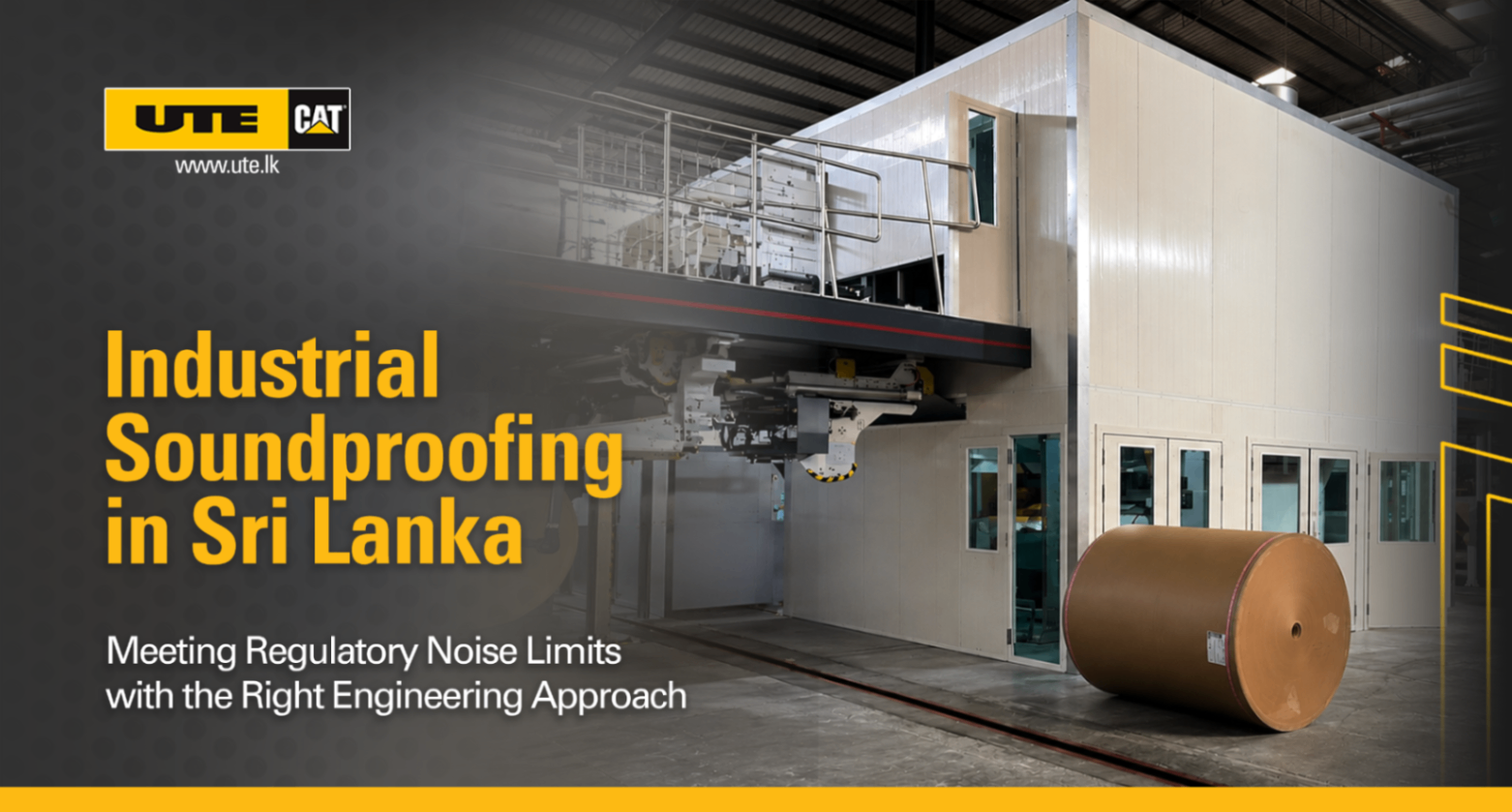
Depending on the problem, engineers may recommend acoustic enclosures, sound-insulating barriers, vibration isolation systems, or a carefully designed combination.
Reverberation calculations, transmission loss analysis and acoustic modelling help assess suitable treatments. The design must also account for ventilation, equipment access and operating conditions. After installation, measurements should verify the achieved attenuation against the agreed targets and applicable requirements.
The UTE Engineering Advantage
At UTE, industrial noise control begins with understanding the problem rather than guessing at the solution.
Our engineering approach includes acoustic site surveys, sound pressure mapping, frequency spectrum analysis and structural vibration assessment. Attenuation calculations and acoustic simulation support the design, followed by performance verification testing.
By applying engineering principles, noise engineers can determine whether a facility requires improved sound absorption, stronger sound isolation, vibration control, or a combination of solutions.
Assessing results against occupational health and environmental requirements is part of this process. A calculated reduction supports design decisions; measured performance establishes what the installed solution achieves.
Successful industrial soundproofing starts with identifying the source and transmission path, selecting suitable controls, and checking the result.
A 3 dB reduction represents approximately 50% less sound energy over the same duration under comparable conditions. Understanding that relationship helps facility managers recognize progress while keeping the remaining noise exposure in view.
Looking to improve industrial noise control at your facility? Connect with UTE to explore suitable acoustic engineering solutions.