Noise Limits with the Right Engineering Approach
Noise control at the industrial level is not merely a technical option in Sri Lanka. It is a compliance requirement. The maximum permissible noise levels are taken at the boundary of the premises and not at the machine itself as per the National Environmental (Noise Control) Regulations No. 1 of 1996, which are enforced by the Regulatory bodies. In the case of industrial zones, the maximum is 70 dB(A) during the day and 60 dB(A) at night. It is a very critical factor that is not taken into consideration by many businesses when they are planning on installing generators or plants.
The difficulty can be made evident when we consider the actual sound levels generated by industrial equipment. A typical diesel generator or other such similar machine or engine can generate approximately 85-110 dB(A) at source. It implies that a facility might have to attain 20-40 dB attenuation prior to the sound reaching the site boundary. In practical terms, it is not realistic to install a machine and expect compliance without an appropriate noise-control plan or strategy.
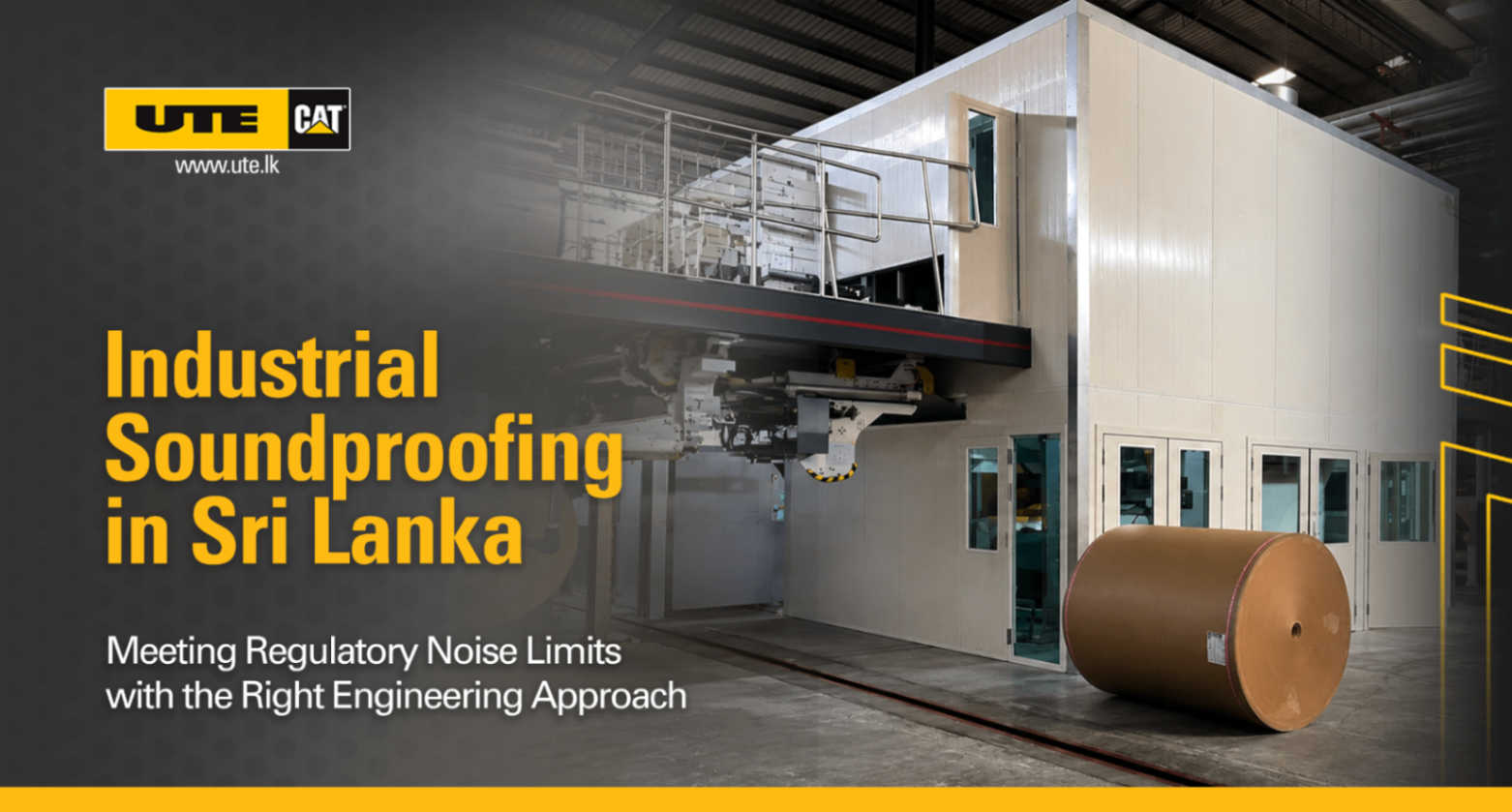
This is where the right engineering approach for industrial soundproofing plays a crucial role. Generally, good sound management involves a combination of solutions rather than a single product. The first choice often is an acoustic enclosure of a DG set, compressor or pump. Nevertheless, enclosures are sometimes not sufficient by themselves. Real compliance can be attained by designing and installing room soundproofing, exhaust and ventilation silencers, anti-vibration isolation, barrier walls and proper layout planning.
This would be best understood by a practical example. A generator which produces 100 dB can be lowered to approximately 75-80 dB by an acoustic enclosure. With this added distance and physical barrier, the noise level can be further reduced to approximately 65-70 dB, which would allow the facility to fit within the CEA limits at the boundary. This demonstrates that compliance cannot be achieved through a single measure, but has to be achieved through a well-thought-out engineering strategy.
Another reason as to why one installation is not successful even after spending a lot of money, needs to be understood. Mistakes made include, only considering the generator with other aspects such as exhaust noise, ventilation openings, lack of vibration isolation, and poor sealing of doors or panels, neglected. Such gaps may form significant paths of noise leak and cause failure of compliance, despite the expensive installation of noise reduction equipment.
In the case of businesses in Sri Lanka, the appropriate soundproofing solution must not just be limited to reducing the noise. It must assist in regulatory compliance, operational reliability and better site planning. Overall, industrial soundproofing is not just a matter of covering noise. It is concerned with creating the correct solution in order to provide performance, compliance and long-term peace of mind.
UTE offers soundproofing services in Sri Lanka using experienced engineering professionals who provide practical solutions which are designed to help the customers to improve the working environment and to provide practical solutions, meeting the compliance challenge of industrial noise, effectively and efficiently.
UTE ~ The Journey Continues… Long After the Sale.
Website: www.ute.lk
Contact: 0771407070| [email protected]
The difficulty can be made evident when we consider the actual sound levels generated by industrial equipment. A typical diesel generator or other such similar machine or engine can generate approximately 85-110 dB(A) at source. It implies that a facility might have to attain 20-40 dB attenuation prior to the sound reaching the site boundary. In practical terms, it is not realistic to install a machine and expect compliance without an appropriate noise-control plan or strategy.
This is where the right engineering approach for industrial soundproofing plays a crucial role. Generally, good sound management involves a combination of solutions rather than a single product. The first choice often is an acoustic enclosure of a DG set, compressor or pump. Nevertheless, enclosures are sometimes not sufficient by themselves. Real compliance can be attained by designing and installing room soundproofing, exhaust and ventilation silencers, anti-vibration isolation, barrier walls and proper layout planning.
This would be best understood by a practical example. A generator which produces 100 dB can be lowered to approximately 75-80 dB by an acoustic enclosure. With this added distance and physical barrier, the noise level can be further reduced to approximately 65-70 dB, which would allow the facility to fit within the CEA limits at the boundary. This demonstrates that compliance cannot be achieved through a single measure, but has to be achieved through a well-thought-out engineering strategy.
Another reason as to why one installation is not successful even after spending a lot of money, needs to be understood. Mistakes made include, only considering the generator with other aspects such as exhaust noise, ventilation openings, lack of vibration isolation, and poor sealing of doors or panels, neglected. Such gaps may form significant paths of noise leak and cause failure of compliance, despite the expensive installation of noise reduction equipment.
In the case of businesses in Sri Lanka, the appropriate soundproofing solution must not just be limited to reducing the noise. It must assist in regulatory compliance, operational reliability and better site planning. Overall, industrial soundproofing is not just a matter of covering noise. It is concerned with creating the correct solution in order to provide performance, compliance and long-term peace of mind.
UTE offers soundproofing services in Sri Lanka using experienced engineering professionals who provide practical solutions which are designed to help the customers to improve the working environment and to provide practical solutions, meeting the compliance challenge of industrial noise, effectively and efficiently.
UTE ~ The Journey Continues… Long After the Sale.
Website: www.ute.lk
Contact: 0771407070| [email protected]