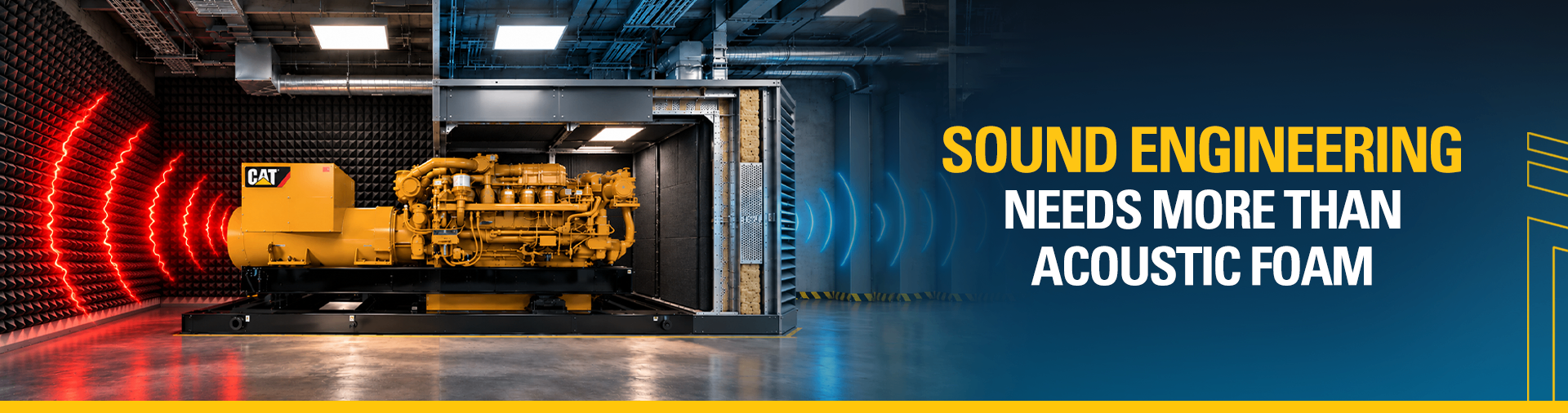
Industrial Soundproofing Materials and Why Acoustic Foam Alone Falls Short
Imagine lining a generator room with acoustic foam. Inside, the room sounds less echoey. Outside, the familiar rumble is still there. The foam may be doing its job, but the noise reaching neighbouring work areas needs a different treatment.
In our previous article, we explained that a 3 dB reduction represents roughly half the sound energy for the same duration under comparable measurement conditions. Once we have measured the noise, the next question is which materials will control it.
Choosing industrial soundproofing materials starts with understanding where the sound travels. Absorption helps control reflections within a space. Sound insulation reduces transmission through walls or enclosures. A generator room usually needs both.
Why standard acoustic foam often falls short
Generators, compressors, pumps and blowers can produce low-frequency rumble as well as vibration that travels through floors and pipework. Their surroundings may also expose acoustic materials to heat, oil, dust and physical damage.
Thin acoustic foam has little mass and generally provides limited sound insulation on its own. It can absorb reflected sound, but low-frequency machinery noise often needs a substantial enclosure and treatment of other transmission paths. Specialist foams do have industrial applications, provided their acoustic performance and environmental ratings suit the job.
Mass loaded vinyl adds acoustic mass
Mass loaded vinyl (MLV) is a dense, flexible barrier used to reduce airborne sound transmission. It can form part of machinery enclosures, acoustic walls and other multilayer constructions.
Its contribution depends on surface mass, installation and the complete construction. Gaps or poorly sealed joints can undermine the result. MLV is one option for industrial sound insulation; a suitably designed solid metal skin may already provide the required barrier. Check the selected product’s temperature and fire performance before specifying it near hot equipment.
High density stone wool absorbs sound energy
Stone wool, often called rockwool, is a type of mineral wool. Its porous fibre structure dissipates acoustic energy as sound enters the material, helping control reflections inside an enclosure.
Density alone does not determine performance. Thickness, airflow resistance, mounting and frequency also matter. A thin absorber that works well at higher frequencies may do little for a deep generator rumble. Select the product using absorption data for the proposed installation. Combining suitable mineral wool with a barrier can improve enclosure performance, but the assembly needs to be assessed as a whole.
Perforated metal protects the absorber
A perforated metal facing protects softer acoustic material against contact and maintenance damage while allowing sound to reach the absorber behind it. The openings and any protective fabric must be chosen so they do not restrict acoustic performance.
The facing is not a dustproof seal, and it does not replace the room’s ventilation system. A typical panel may have a solid outer metal skin, a barrier layer where needed, mineral wool and a perforated facing towards the noise source.
Thermal acoustic composites must suit the operating conditions
Composite systems combine materials to address acoustic and thermal requirements. For generator room soundproofing, that means checking the temperature limits and fire behaviour of the full assembly, including facings and adhesives.
Thermal insulation does not remove heat from the room. The generator still needs adequate combustion and cooling air, with safe exhaust discharge. Acoustic louvers or ventilation silencers must be sized for the required airflow and acceptable pressure drop. Simply closing an opening to stop noise can lead to overheating.
Four principles guide effective factory soundproofing
Before choosing panels, trace the noise from the machine to the people or neighbouring properties affected. Four principles help organise the work:
Block airborne sound using suitable walls, barriers or enclosures.
Absorb reflected sound with an appropriate internal lining.
Isolate machinery vibration using correctly selected mounts and flexible connections where required.
Seal unintended gaps around doors, joints and service penetrations, while treating necessary ventilation openings acoustically.
If vibration is entering the building through the floor, more wall lining will have limited benefit. If noise escapes through an untreated air outlet, improving the wall alone may barely change the level outside.
Bringing the generator room system together
For a generator room, the design may combine an enclosure with adequate acoustic mass, MLV where needed, stone wool behind perforated metal, vibration isolators and acoustic ventilation silencers. Exhaust noise needs its own suitable silencer. These treatments address different paths, so their selection depends on the measured noise spectrum, cooling requirements and agreed noise limit.
The UTE Engineering approach
At UTE, our approach begins with understanding the equipment and how noise travels through the site. Depending on the project, this can include acoustic surveys, sound-pressure measurements, frequency analysis, vibration assessment and attenuation calculations.
Those findings guide material selection and the design of custom enclosures or panels, together with ventilation and maintenance access. Once installed, the system’s performance should be verified against the agreed target, with measurements taken at the relevant locations under comparable operating conditions.
For a facility manager, the useful question is where the noise is escaping and what treatment will reduce it. That answer should come before the material order.
Contact UTE to discuss industrial soundproofing materials and an engineered noise control solution for your facility.