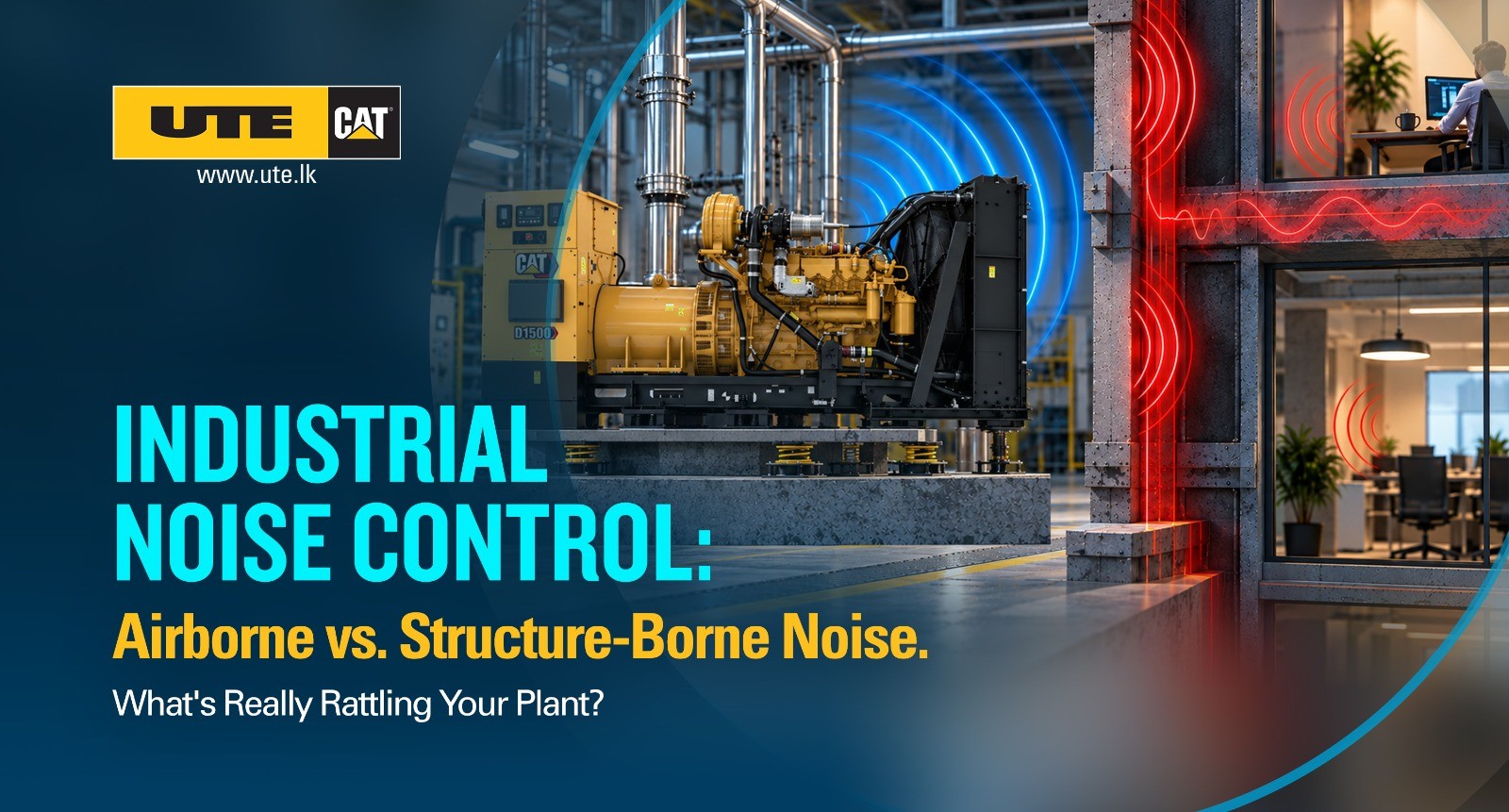
Airborne vs. Structure-Borne Noise. What's Really Rattling Your Plant?
A new compressor goes into the plant. To keep things quiet, the room is lined with thick acoustic panels, the kind that usually work beautifully. Weeks later, someone on a different floor complains that their desk is humming and their coffee cup rattles.
The panels didn't fail. They were never going to fix this problem. There are two very different kinds of noise in a building, and most soundproofing deals with only one.
What Is Industrial Noise?
Industrial noise is unwanted sound and vibration from plant equipment and processes. In most facilities it comes from several sources at once:
- Rotating equipment - pumps, fans, motors, compressors, chillers
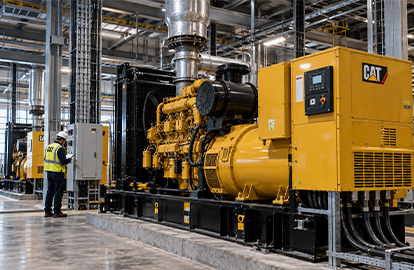
- Reciprocating machinery - piston compressors, diesel generators
- Impact processes - punch presses, stamping lines, crushers
- Fluid and airflow - duct turbulence, valve throttling, air discharge
- Building services - AHUs, cooling towers, lifts, pump rooms
Each releases energy in two directions at once: into the air, and into whatever it's bolted to.
Airborne vs. Structure-Borne Noise
Airbone Noise
Airborne noise travels through the air to your ears, the way your voice carries across a room. A motor's whine or a fan's whir is airborne noise. It is:
- Loudest close to the source, fading with distance
- Mostly mid and high frequency
- Controlled by panels, barriers, enclosures, and silencers
Structure-borne noise
Structure borne noise works differently. It moves as physical shaking through the building itself, the concrete slab, the steel beams, the columns. Think of feeling a neighbour's bass through your floor with every window shut: the building is carrying the vibration for the machine. It is:
- Transmitted as structure borne vibration through slabs, beams, columns, and pipework
- Barely weakened by distance, since concrete and steel carry vibration efficiently
- Low frequency, often felt as a rumble as much as heard
- Re-radiated as noise from walls and ceilings far from the source
- Unaffected by acoustic absorption
That's the trap. A pump can be almost silent beside it yet clearly noticeable four floors away, because you're hearing the building, not the equipment.
Why More Panels Won't Help
Panels absorb sound waves moving through open air. Structure-borne vibrations never enter the air, they're already inside the concrete and steel. No amount of wall padding stops something shaking the floor itself. The only real fix is decoupling: separating the equipment from the building so its vibration has nowhere to go.
Real Industrial Examples
- Rooftop chillers above offices. The plant room is quiet, but the floor two levels down reports a low hum travelling down the columns.
- Basement generator sets in hotels and hospitals. During weekly testing, guest rooms eight floors up report a rumble.
- Punch presses and stamping lines. Each impact sends a shock pulse through the slab into adjacent labs, disturbing sensitive equipment before it disturbs people.
- Pump skids in process plants. Rigid pipework bridges the isolators, carrying vibration far beyond the machine.
More absorption in the plant room would have changed nothing here
Industrial Noise Control Methods That Actually Work
Effective industrial noise and vibration control matches the method to the transmission path:
- Heavy concrete inertia bases. Added mass makes the machine harder to move in the first place, a heavy table wobbles less than a light one. Best for large pumps, chillers, and generator sets.
- Spring isolators. Springs let equipment bounce gently in place instead of driving its shaking into the floor, like a car's suspension absorbing road bumps. Deflection must match operating speed; an undersized spring can sit near resonance and make things worse.
- Rubber and elastomeric pads. These absorb the smaller, quicker shocks springs alone might miss. Best for pumps, fans, and motors on stiff ground-bearing slabs.
- Flexible connectors and resilient hangers. Isolating a machine achieves little if rigid pipes and ducts bypass it, the most common reason a good specification underperforms.
Enclosures, lagging, and absorption. Still the right answer for genuinely airborne problems, delivering real industrial noise reduction where the path is through the air.
None of these are one-size-fits-all. The right idea in the wrong place means real money spent on a fix that hardly helps.
Explore UTE's vibration isolation solutions and HVAC and MEP engineering services.
The UTE Diagnostic Advantage
Most noise complaints go wrong the same way: someone assumes it's airborne, orders panels, and learns weeks later that the building is still shaking.
At UTE, we don't start with guesswork. Our engineers run an on-site vibration diagnostic, tracing how energy moves through your floors, beams, columns, and pipework. That tells us whether the problem is airborne, structure-borne, or both and which combination of inertia bases, springs, and pads will solve it for your equipment and structure.
Learn more about our on-site vibration diagnostics.
Stop Guessing. Start Diagnosing.
Not every noise problem is solved by a thicker wall. Sometimes the real issue is hidden inside the building itself, and the only way to fix it for good is to diagnose it first.
If something in your facility is humming, rumbling, or rattling, talk to UTE. We'll identify the true transmission path and recommend the industrial noise control solution that solves it.
Book a noise and vibration assessment with UTE →









 BACK
BACK